
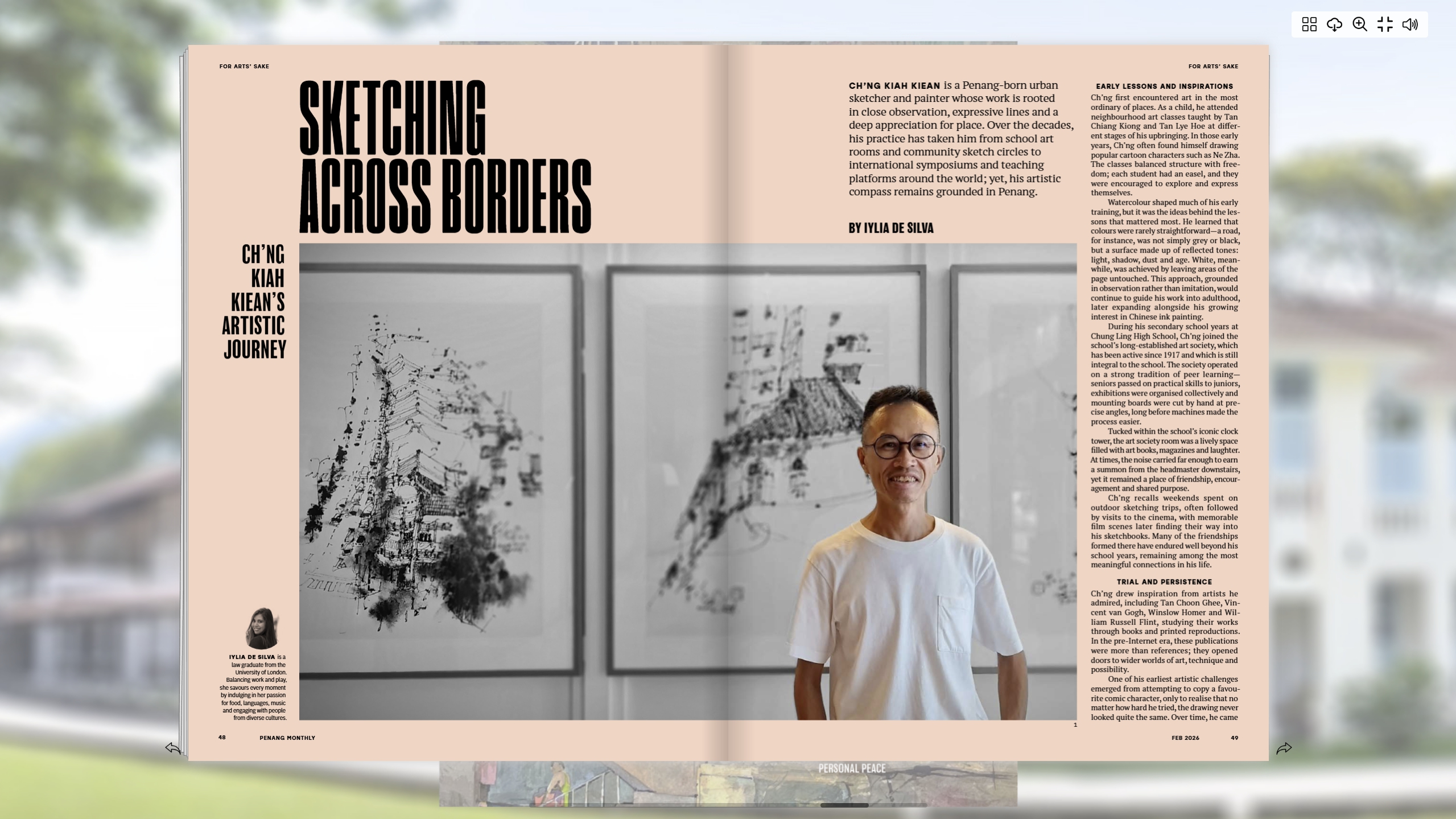
CH’NG KIAH KIEAN is a Penang-born urban sketcher and painter whose work is rooted in close observation, expressive lines and a deep appreciation for place. Over the decades, his practice has taken him from school art rooms and community sketch circles to international symposiums and teaching platforms around the world; yet, his artistic compass remains grounded in Penang.
EARLY LESSONS AND INSPIRATIONS
Ch’ng first encountered art in the most ordinary of places. As a child, he attended neighbourhood art classes taught by Tan Chiang Kiong and Tan Lye Hoe at different stages of his upbringing. In those early years, Ch’ng often found himself drawing popular cartoon characters such as Ne Zha. The classes balanced structure with freedom; each student had an easel, and they were encouraged to explore and express themselves.
Watercolour shaped much of his early training, but it was the ideas behind the les-sons that mattered most. He learned that colours were rarely straightforward—a road, for instance, was not simply grey or black, but a surface made up of reflected tones: light, shadow, dust and age. White, meanwhile, was achieved by leaving areas of the page untouched. This approach, grounded in observation rather than imitation, would continue to guide his work into adulthood, later expanding alongside his growing interest in Chinese ink painting.
During his secondary school years at Chung Ling High School, Ch’ng joined the school’s long-established art society, which has been active since 1917 and which is still integral to the school. The society operated on a strong tradition of peer learning—seniors passed on practical skills to juniors, exhibitions were organised collectively and mounting boards were cut by hand at precise angles, long before machines made the process easier.
Tucked within the school’s iconic clock tower, the art society room was a lively space filled with art books, magazines and laughter. At times, the noise carried far enough to earn a summon from the headmaster downstairs, yet it remained a place of friendship, encouragement and shared purpose.
Ch’ng recalls weekends spent on outdoor sketching trips, often followed by visits to the cinema, with memorable film scenes later finding their way into his sketchbooks. Many of the friendships formed there have endured well beyond his school years, remaining among the most meaningful connections in his life.
TRIAL AND PERSISTENCE
Ch’ng drew inspiration from artists he admired, including Tan Choon Ghee, Vincent van Gogh, Winslow Homer and William Russell Flint, studying their works through books and printed reproductions. In the pre-Internet era, these publications were more than references; they opened doors to wider worlds of art, technique and possibility.
One of his earliest artistic challenges emerged from attempting to copy a favourite comic character, only to realise that no matter how hard he tried, the drawing never looked quite the same. Over time, he came to understand that a personal style does not arise from perfect imitation, but from years of experimentation, failed attempts and persistent questioning of what makes one’s work distinct.
Motivation, he says, rarely emerges in isolation. Support from friends and peers matters, not only for encouragement, but also for critique. “The scariest thing is when an artist cannot see their own problem, or believes they are already the best,” he observes.
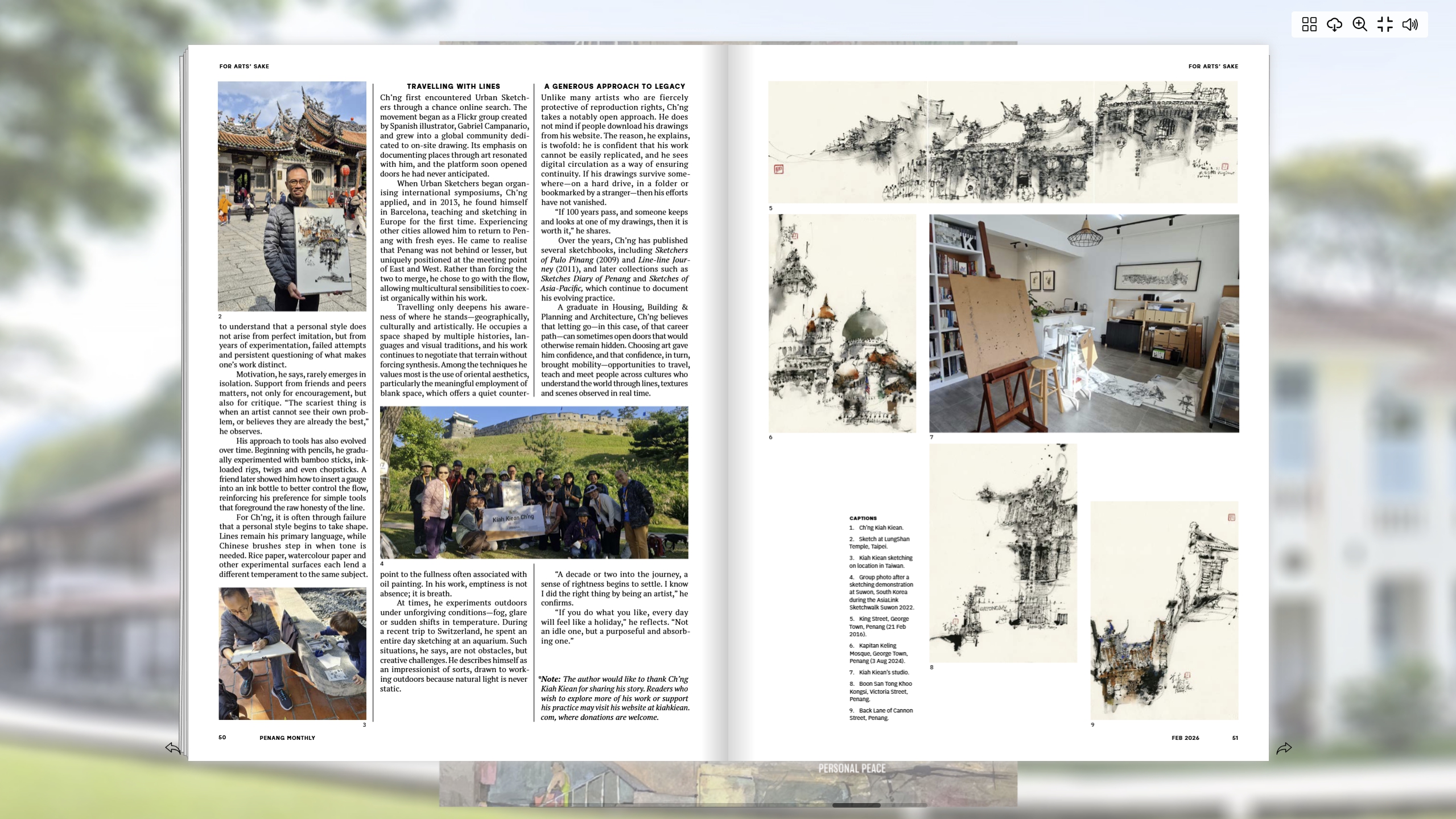
His approach to tools has also evolved over time. Beginning with pencils, he gradually experimented with bamboo sticks, ink-loaded rigs, twigs and even chopsticks. A friend later showed him how to insert a gauge into an ink bottle to better control the flow, reinforcing his preference for simple tools that foreground the raw honesty of the line.
For Ch’ng, it is often through failure that a personal style begins to take shape. Lines remain his primary language, while Chinese brushes step in when tone is needed. Rice paper, watercolour paper and other experimental surfaces each lend a different temperament to the same subject.
TRAVELLING WITH LINES
Ch’ng first encountered Urban Sketch-ers through a chance online search. The movement began as a Flickr group created by Spanish illustrator, Gabriel Campanario, and grew into a global community dedicated to on-site drawing. Its emphasis on documenting places through art resonated with him, and the platform soon opened doors he had never anticipated.
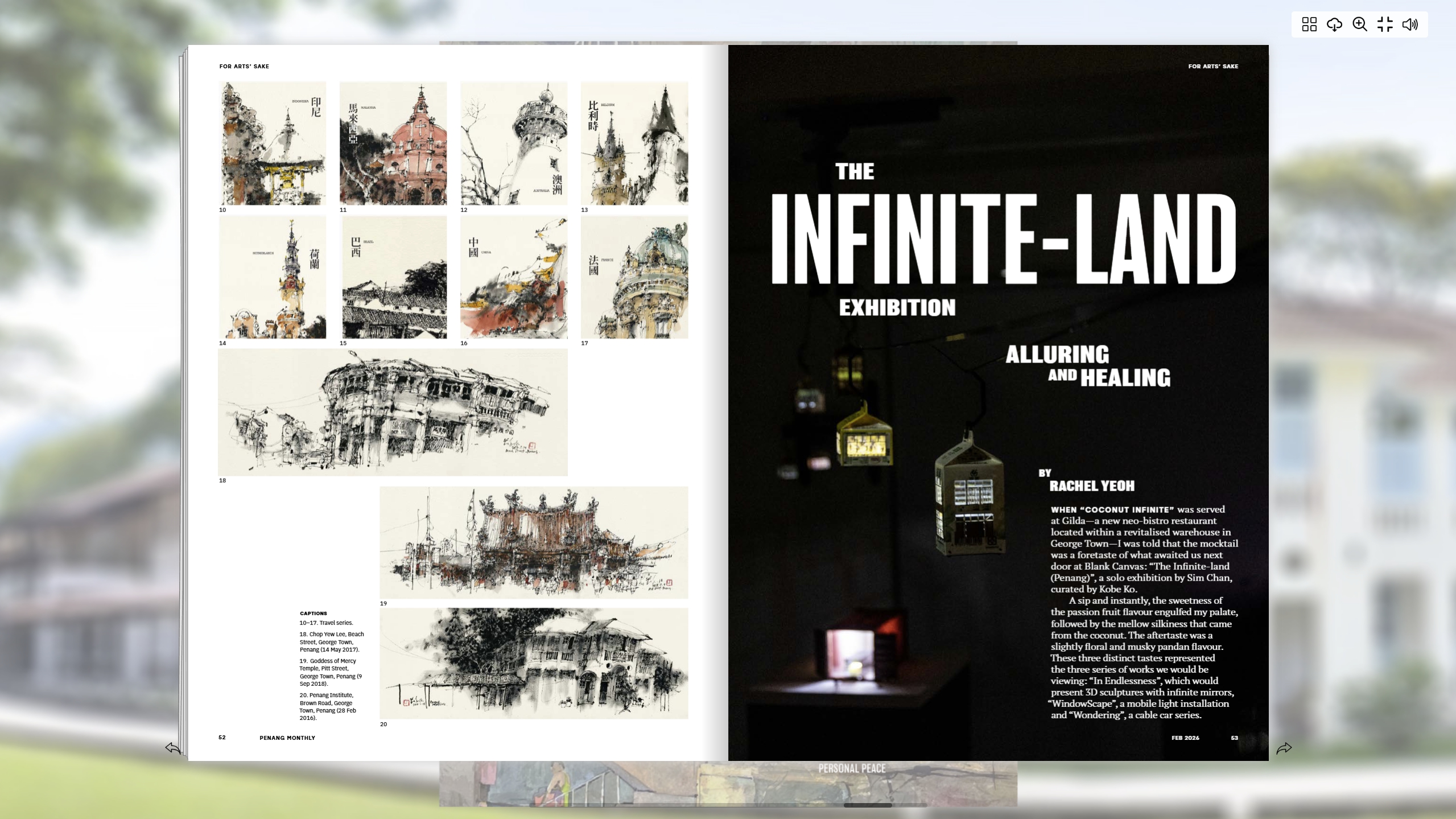
When Urban Sketchers began organising international symposiums, Ch’ng applied, and in 2013, he found himself in Barcelona, teaching and sketching in Europe for the first time. Experiencing other cities allowed him to return to Penang with fresh eyes. He came to realise that Penang was not behind or lesser, but uniquely positioned at the meeting point of East and West. Rather than forcing the two to merge, he chose to go with the flow, allowing multicultural sensibilities to coexist organically within his work.
Travelling only deepens his awareness of where he stands—geographically, culturally and artistically. He occupies a space shaped by multiple histories, languages and visual traditions, and his work continues to negotiate that terrain without forcing synthesis. Among the techniques he values most is the use of oriental aesthetics, particularly the meaningful employment of blank space, which offers a quiet counterpoint to the fullness often associated with oil painting. In his work, emptiness is not absence; it is breath.
At times, he experiments outdoors under unforgiving conditions—fog, glare or sudden shifts in temperature. During a recent trip to Switzerland, he spent an entire day sketching at an aquarium. Such situations, he says, are not obstacles, but creative challenges. He describes himself as an impressionist of sorts, drawn to working outdoors because natural light is never static.
A GENEROUS APPROACH TO LEGACY
Unlike many artists who are fiercely protective of reproduction rights, Ch’ng takes a notably open approach. He does not mind if people download his drawings from his website. The reason, he explains, is twofold: he is confident that his work cannot be easily replicated, and he sees digital circulation as a way of ensuring continuity. If his drawings survive somewhere—on a hard drive, in a folder or bookmarked by a stranger—then his efforts have not vanished.
“If 100 years pass, and someone keeps and looks at one of my drawings, then it is worth it,” he shares.
Over the years, Ch’ng has published several sketchbooks, including Sketchers of Pulo Pinang (2009) and Line-line Jour-ney (2011), and later collections such as Sketches Diary of Penang and Sketches of Asia-Pacific, which continue to document his evolving practice.
A graduate in Housing, Building & Planning and Architecture, Ch’ng believes that letting go—in this case, of that career path—can sometimes open doors that would otherwise remain hidden. Choosing art gave him confidence, and that confidence, in turn, brought mobility—opportunities to travel, teach and meet people across cultures who understand the world through lines, textures and scenes observed in real time.
“A decade or two into the journey, a sense of rightness begins to settle. I know I did the right thing by being an artist,” he confirms.
“If you do what you like, every day will feel like a holiday,” he reflects. “Not an idle one, but a purposeful and absorbing one.”
*Note: The author would like to thank Ch’ng Kiah Kiean for sharing his story. Readers who wish to explore more of his work or support his practice may visit his website at kiahkiean.com, where donations are welcome.
Find out more at https://www.penangmonthly.com/sketching-across-borders-chng-kiah-kieans-artistic-journey/
Leave a Reply